
For commercial photographers
Show the work, the brief and the usage.
An art director or a brand manager is not falling in love with a wedding. They are checking whether you have shot something like their job, whether you understand the brief and what it will cost to use the pictures. Your site has to answer all three quickly, and make asking for a quote easy. We build the whole site before you pay anything.
See the looks
Open one. They are both live.
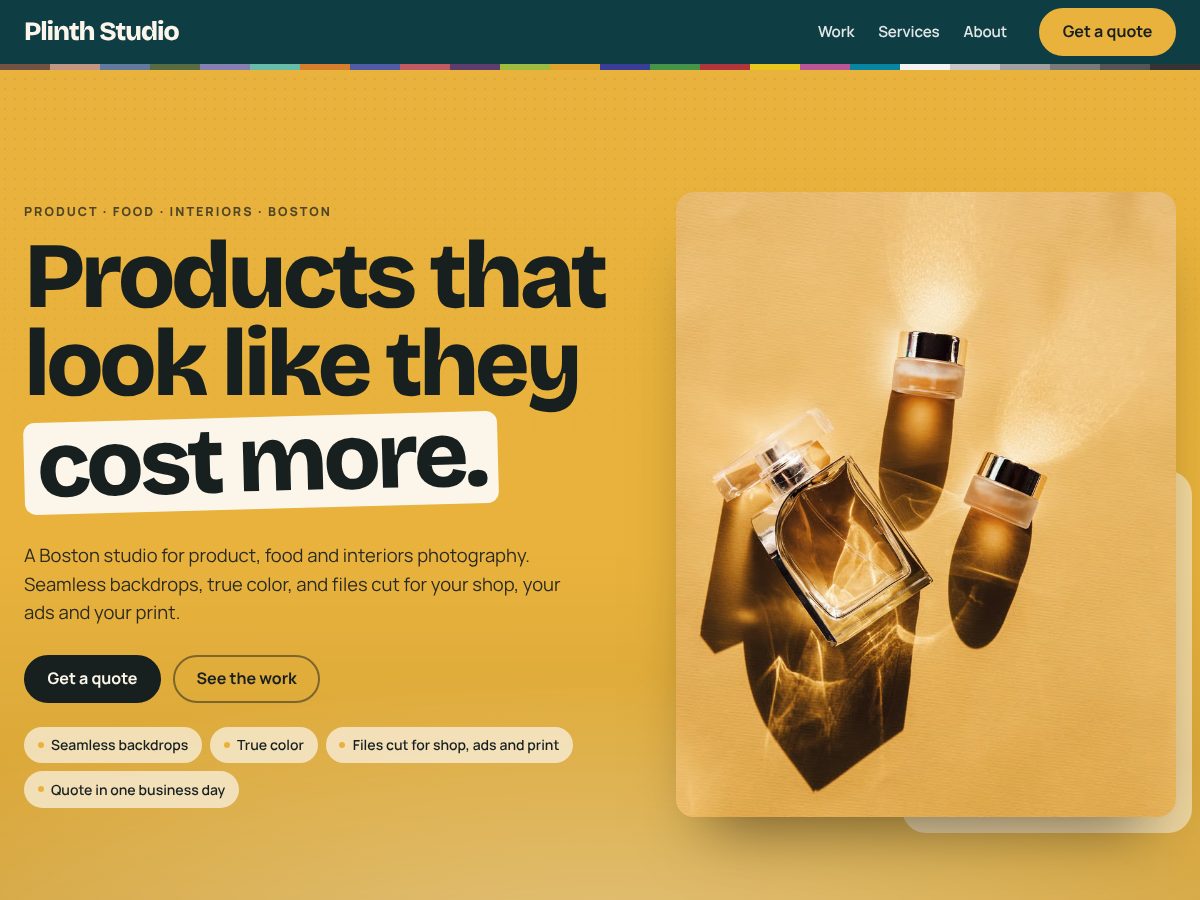 Example site · Colored paper backdrops
A made-up Boston studio for product, food and interiors work: mustard, sage and blush backdrops, a filtered portfolio, project pages, a licensing section and a quick quote builder.
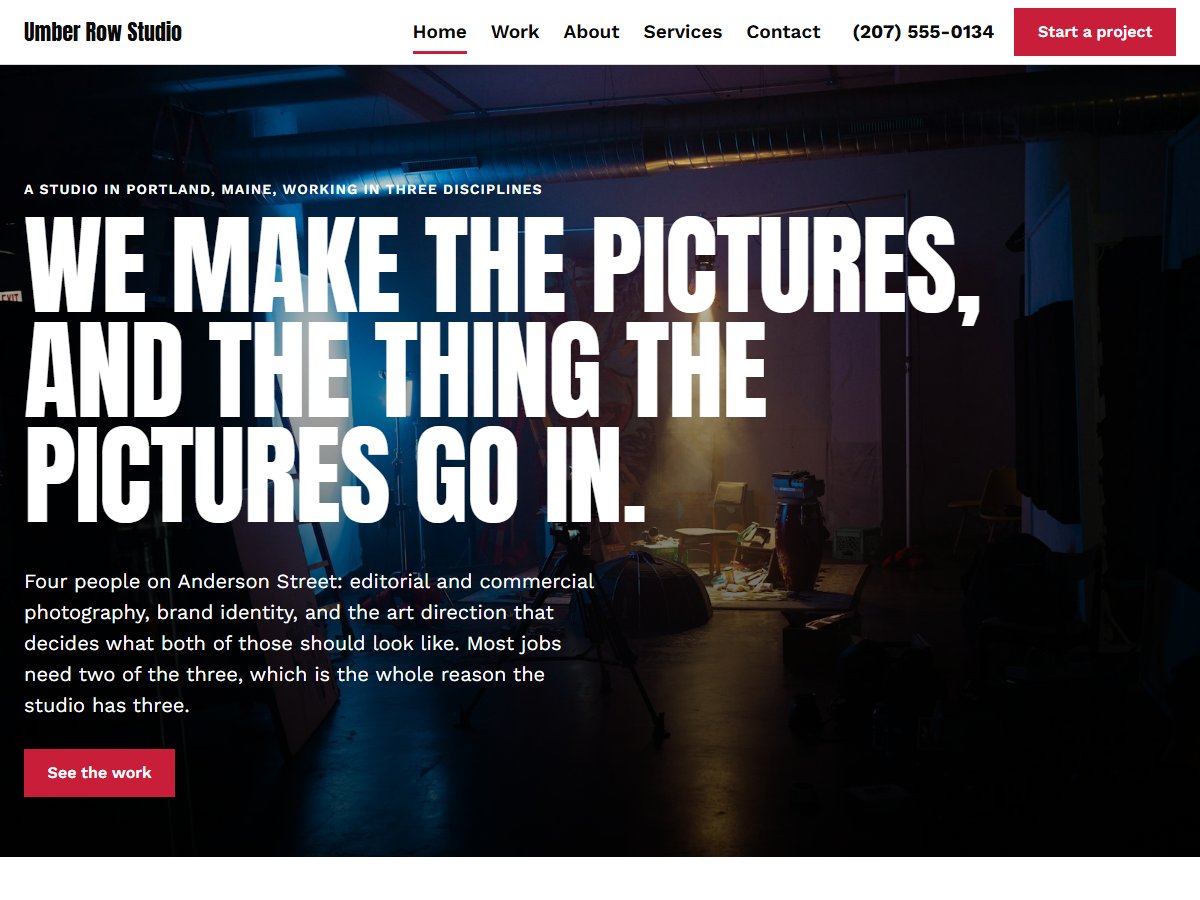 Example site · Bold and immersive
Photography at full screen and a wall of work with nothing in the way, for a photographer who lets the pictures lead.
What buyers check first
Three questions a commercial buyer is asking.
Have you shot something like my job?
A bottle, a plated dish, a staged living room. Buyers look for work close to their own, so a portfolio you can filter by kind of work beats one long scroll.
Do you understand the brief?
A picture alone says little about how you got there. A short project page with the brief, what you did and the result shows that you think like the person who hired you.
What will it cost to use these?
Where the pictures run, for how long and in which markets decides the fee. A clear licensing section saves both sides an hour of back and forth.
The first minute
What an art director sees before they write.
- 01
Work that looks like their job
Product, food, interiors, each with its own filter, so nobody scrolls through weddings to find a table setting.
- 02
A project, not just a picture
The brief, the setup and the final frames on one page, with the client named if they agree.
- 03
Usage in plain words
What a license usually covers, and how it changes the fee, in a few honest lines.
- 04
A quote they can start at once
A few taps instead of a blank contact box, sent to you as a filled-in form.
Three ways to show the work
A PDF, a photo template, or a site built around projects.
| An emailed PDF | A photo-only template | A project-led site | |
|---|---|---|---|
| Shows the work | Yes, once, as attached | Yes, in one long gallery | Yes, filtered by kind of work |
| Explains the brief | Only if you write it each time | Rarely, there is nowhere to put it | On each project page |
| States usage | In your email, if you remember | Usually missing | A licensing section you control |
| Gets you a quote request | A reply to your email | A contact box | A short quote builder and a form |
| Stays up to date | You resend the file | You edit it yourself | You email new work and we add it |
A comparison of approaches, not of any one company. Yours is drawn around your own work.
How a quote request works
A few taps, then a filled-in form.
From first look to a quote
The buyer chooses, you receive the details.
Instead of a blank message, the buyer picks what they need and the choices arrive in your inbox already written out.
- They choose what they needA few taps for the kind of job, the amount of work and the timing. You decide the questions.
- They see a rangeIf you want it, a rough price range appears on the spot. If you would rather quote by hand, it leaves the price out.
- The form is already filled inTheir choices are in the message. They add a name, a company and a deadline.
- You answer with a real quoteYou reply from your inbox with the number and the terms you stand behind.
What we set up for you
Everything below comes with your site.
-
A filtered portfolio
See the galleryWork grouped by kind, with a full-screen viewer and your strongest frames first.
-
Project pages
The brief, the approach and the result, one page for each job you want to show.
-
A licensing section
What usage typically covers and how it changes the fee, in words you choose.
-
Client logos and kind words
Names and quotes from people who agreed to be shown, nothing invented.
-
Changes by email
Send a new project and a few lines. It is up within a day.
From the blog
Read more.
- What does a website score really mean? How our PageTend Score worksWhere a site loses points, and which ones are quick to win back.
- Who owns your website? Domain, hosting and words, explainedThree things people mean by "my website", and who holds each one.
- Website design and hosting: bundled or bought separately?What you pay for, and who fixes it when something breaks.
Plainly
Some honest things.
The studio here is made up
Plinth Studio, its clients, prices and reviews are invented, and the photographs are free stock photos. Yours is built from your own work.
Licensing wording is yours
We set up the section and write it with you. What your license actually allows is your decision, and we are not lawyers.
Contracts and invoices stay with you
We do not handle estimates you send, contracts, invoices or payments. A quoting or booking system with deposits is a separate, quoted project.
Questions
What commercial photographers ask first.
Should I show prices?
Many commercial photographers show none, because the fee depends on usage. A quote builder with a range, or a plain invitation to ask, are both common. We build either.
Can I name my clients?
Only the ones who agreed. Everything on the site is what you send us, so the choice stays with you.
Can the portfolio be filtered by kind of work?
Yes. Product, food, interiors or whatever groups you shoot, each with its own filter.
Do you use my photographs only?
Yes. Until yours arrive we use plain placeholders, never someone else's pictures.
Do you handle estimates, contracts or invoices?
No. The site collects the quote request, and the estimate, contract and invoice stay in the tools you already use.
What does it cost?
$99 a month, month to month, no design or setup fee. See pricing.
Tell us what you shoot and who hires you.
Send us a few of your best projects and a line about your clients. We build a real site and email you the link before you pay anything.